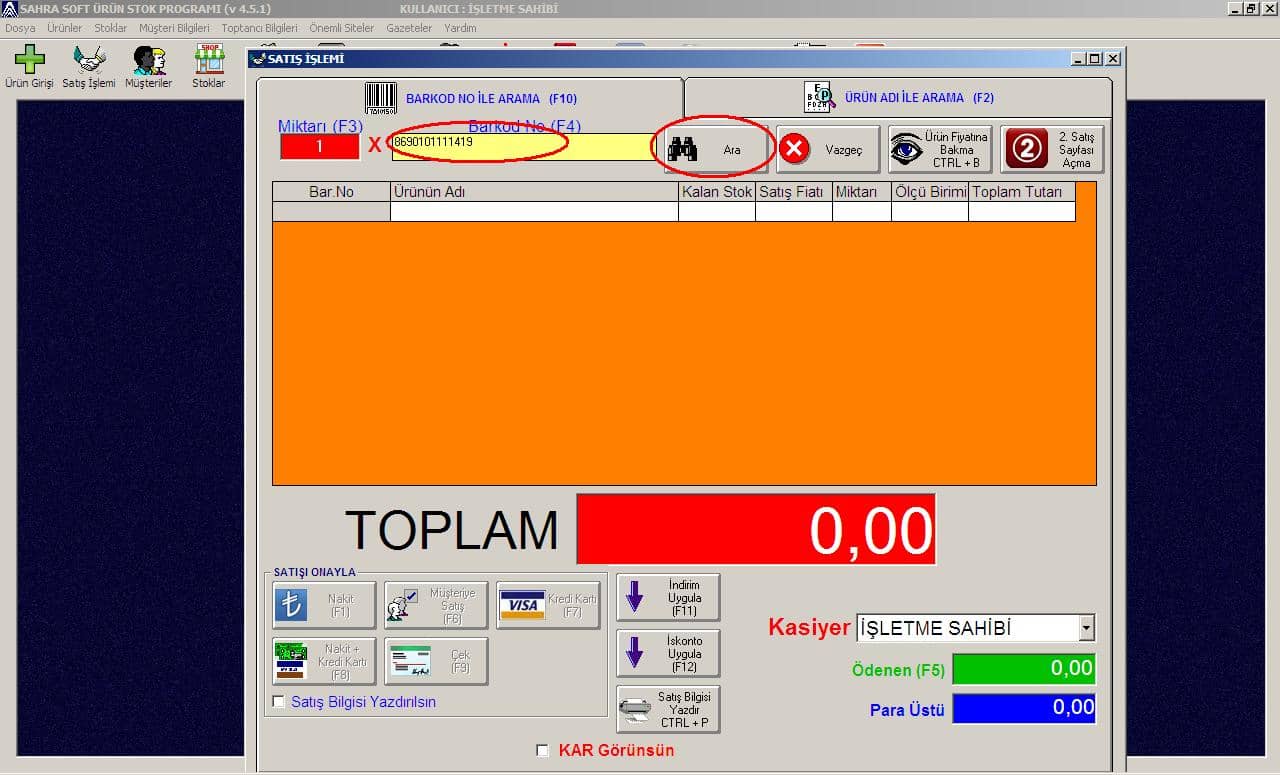
Barkod Okuma Program
пятница 03 апреля admin 95
A barcode reader (or barcode scanner) is an optical scanner that can read printed barcodes, decode the data contained in the barcode and send the data to a computer. Like a flatbed scanner, it consists of a light source, a lens and a light sensor translating for optical impulses into electrical signals. Additionally, nearly all barcode readers contain decoder circuitry that can analyze the barcode's image data provided by the sensor and sending the barcode's content to the scanner's output port.
Join our loyalty program, VIPeak (for free!) and earn Points to get Rewards, early access to limited collections, plus gifts, milestones and more. Scan your driver's. No information is available for this page.Learn why.
Types of barcode scanners[edit]
Technology[edit]
Barcode readers can be differentiated by technologies as follows:
Pen-type readers[edit]
Pen-type readers consist of a light source and photodiode that are placed next to each other in the tip of a pen. To read a barcode, the person holding the pen must move the tip of it across the bars at a relatively uniform speed. The photodiode measures the intensity of the light reflected back from the light source as the tip crosses each bar and space in the printed code. The photodiode generates a waveform that is used to measure the widths of the bars and spaces in the barcode. Dark bars in the barcode absorb light and white spaces reflect light so that the voltage waveform generated by the photodiode is a representation of the bar and space pattern in the barcode. Delly ranx the next chapter rar extractor reviews. This waveform is decoded by the scanner in a manner similar to the way Morse code dots and dashes are decoded.
Laser scanners[edit]
Laser scanners work the same way as pen-type readers except that they use a laser beam as the light source and typically employ either a reciprocating mirror or a rotating prism to scan the laser beam back and forth across the barcode. As with the pen-type reader, a photo-diode is used to measure the intensity of the light reflected back from the barcode. In both pen readers and laser scanners, the light emitted by the reader is rapidly varied in brightness with a data pattern and the photo-diode receive circuitry is designed to detect only signals with the same modulated pattern.
CCD readers (also known as LED scanners)[edit]
CCD readers use an array of hundreds of tiny light sensors lined up in a row in the head of the reader. Each sensor measures the intensity of the light immediately in front of it. Each individual light sensor in the CCD reader is extremely small and because there are hundreds of sensors lined up in a row, a voltage pattern identical to the pattern in a barcode is generated in the reader by sequentially measuring the voltages across each sensor in the row. The important difference between a CCD reader and a pen or laser scanner is that the CCD reader is measuring emitted ambient light from the barcode whereas pen or laser scanners are measuring reflected light of a specific frequency originating from the scanner itself. LED scanners can also be made using CMOS sensors, and are replacing earlier Laser-based readers.[1][better source needed]
Camera-based readers[edit]
Two-dimensional imaging scanners are a newer type of barcode reader. They use a camera and image processing techniques to decode the barcode. Easeus data recovery keygen.
Video camera readers use small video cameras with the same CCD technology as in a CCD barcode reader except that instead of having a single row of sensors, a video camera has hundreds of rows of sensors arranged in a two dimensional array so that they can generate an image.
Large field-of-view readers use high resolution industrial cameras to capture multiple bar codes simultaneously. All the bar codes appearing in the photo are decoded instantly (ImageID patents and code creation tools) or by use of plugins (e.g. the Barcodepedia used a flash application and some web cam for querying a database), have been realized options for resolving the given tasks.
Omnidirectional barcode scanners[edit]
Omnidirectional scanning uses 'series of straight or curved scanning lines of varying directions in the form of a starburst, a Lissajous curve, or other multiangle arrangement are projected at the symbol and one or more of them will be able to cross all of the symbol's bars and spaces, no matter what the orientation.[2] Almost all of them use a laser. Unlike the simpler single-line laser scanners, they produce a pattern of beams in varying orientations allowing them to read barcodes presented to it at different angles. Most of them use a single rotating polygonal mirror and an arrangement of several fixed mirrors to generate their complex scan patterns.
Omnidirectional scanners are most familiar through the horizontal scanners in supermarkets, where packages are slid over a glass or sapphire window. There are a range of different omnidirectional units available which can be used for differing scanning applications, ranging from retail type applications with the barcodes read only a few centimetres away from the scanner to industrial conveyor scanning where the unit can be a couple of metres away or more from the code. Omnidirectional scanners are also better at reading poorly printed, wrinkled, or even torn barcodes.
Cell phone cameras[edit]
While cell phone cameras without auto-focus are not ideal for reading some common barcode formats, there are 2D barcodes which are optimized for cell phones, as well as QR Codes (Quick Response) codes and Data Matrix codes which can be read quickly and accurately with or without auto-focus.[3]
Cell phone cameras open up a number of applications for consumers. For example:
- Movies: DVD/VHS movie catalogs.
- Music: CD catalogs – playing an MP3 when scanned.
- Book catalogs and device.
- Groceries, nutrition information, making shopping lists when the last of an item is used, etc.
- Personal Property inventory (for insurance and other purposes) code scanned into personal finance software when entering. Later, scanned receipt images can then be automatically associated with the appropriate entries. Later, the barcodes can be used to rapidly weed out paper copies not required to be retained for tax or asset inventory purposes.
- If retailers put barcodes on receipts that allowed downloading an electronic copy or encoded the entire receipt in a 2D barcode, consumers could easily import data into personal finance, property inventory, and grocery management software. Receipts scanned on a scanner could be automatically identified and associated with the appropriate entries in finance and property inventory software.
- Consumer tracking from the retailer perspective (for example, loyalty card programs that track consumers purchases at the point of sale by having them scan a QR code).
A number of enterprise applications using cell phones are appearing:
- Access control (for example, ticket validation at venues), inventory reporting (for example, tracking deliveries), asset tracking (for example, anti-counterfeiting).[4]
Smartphones[edit]
- Smartphones can be used in Google's mobile Android operating system via both their own Google Goggles application. Nokia's Symbian operating system features a barcode scanner which can scan barcodes, while mbarcode is a barcode reader for the Maemo operating system. In the Apple iOS, a barcode reader is natively supported within the camera app. With BlackBerry devices, the App World application can natively scan barcodes. Windows Phone 8 is able to scan barcodes through the Bing search app.
Housing[edit]
Barcode readers can be distinguished based on housing design as follows:
- Handheld scanner
- with a handle and typically a trigger button for switching on the light like this are used in factory and farm automation for quality management and shipping.
- PDA scanner (or Auto-ID PDA)
- a PDA with a built-in barcode reader or attached barcode scanner.
- Automatic reader
- a back office equipment to read barcoded documents at high speed (50,000/hour).
- Cordless scanner (or Wireless scanner)
- a cordless barcode scanner is operated by a battery fit inside it and is not connected to the electricity mains and transfer data to the connected device like PC.
Methods of connection[edit]
Early serial interfaces[edit]
Early barcode scanners, of all formats, almost universally used the then-common RS-232 serial interface. This was an electrically simple means of connection and the software to access it is also relatively simple, although needing to be written for specific computers and their serial ports.
Proprietary interfaces[edit]
There are a few other less common interfaces. These were used in large EPOS systems with dedicated hardware, rather than attaching to existing commodity computers. In some of these interfaces, the scanning device returned a 'raw' signal proportional to the intensities seen while scanning the barcode. This was then decoded by the host device. In some cases the scanning device would convert the symbology of the barcode to one that could be recognized by the host device, such as Code 39.
Keyboard wedge (e.g. PS/2)[edit]
With the popularity of the PC and its standard keyboard interface, it became ever easier to connect physical hardware to a PC and so there was commercial demand similarly to reduce the complexity of the associated software. 'Keyboard wedge' hardware plugged between the PS/2 port and the keyboard, with characters from the barcode scanner appearing exactly as if they had been typed at the keyboard. This made the addition of simple barcode reading abilities to existing programs very easy, without any need to change them, although it did require some care by the user and could be restrictive in the content of the barcodes that could be handled.
USB[edit]
Later barcode readers began to use USB connectors rather than the keyboard port, as this became a more convenient hardware option. To retain the easy integration with existing programs, a device driver called a 'software wedge' could be used, to emulate the keyboard-impersonating behavior of the old 'keyboard wedge' hardware.
In many cases, a choice of USB interface types (HID, CDC) are provided. Some have PoweredUSB.
Wireless networking[edit]
Some modern handheld barcode readers can be operated in wireless networks according to IEEE 802.11g (WLAN) or IEEE 802.15.1 (Bluetooth). Some barcode readers also support radio frequencies viz. 433 MHz or 910 MHz. Readers without external power sources require their batteries be recharged occasionally, which may make them unsuitable for some uses.
Resolution[edit]
The scanner resolution is measured by the size of the dot of light emitted by the reader. If this dot of light is wider than any bar or space in the bar code, then it will overlap two elements (two spaces or two bars) and it may produce wrong output. On the other hand, if a too small dot of light is used, then it can misinterpret any spot on the bar code making the final output wrong.
The most commonly used dimension is 13 thou (0.013 in or 0.33 mm), although some scanners can read codes with dimensions as small as 3 thou (0.003 in or 0.075 mm). Most manufacturers advertise bar code resolution in mil, which is interchangeable with thou. Smaller bar codes must be printed at high resolution to be read accurately.
See also[edit]
- CueCat, a cat-shaped handheld barcode reader
- Barcode Battler, a portable game console which scans barcodes as part of the gameplay
- Barcode for more details about the Barcode technology
References[edit]
- ^'Considerations when introducing LED illumination in to the area where barcodes are being scanned?'. support.honeywellaidc.com. September 25, 2019.
- ^Roger C. Palmer. The Bar Code Book.
- ^Alapetite, A (2010). 'Dynamic 2D-barcodes for multi-device web session migration including mobile phones'. Personal and Ubiquitous Computing. 14 (1): 45–52. doi:10.1007/s00779-009-0228-5.
- ^Barcode reading apps for enterprise, codeREADr.com, 2010.
| Wikimedia Commons has media related to Barcode scanners. |
Today’s blog post on reading barcodes and QR codes with OpenCV is inspired by a question I received from PyImageSearch reader, Hewitt:Hey Adrian, I really love the PyImageSearch blog. I look forward to your emails each week. Keep doing what you’re doing.I have a question for you:Does OpenCV have any modules that can be used to read barcodes or QR codes? Or do I need to use an entirely separate library?Thanks Adrian.Great question, Hewitt.The short answer is no, OpenCV does not have any dedicated modules that can be used to read and decode barcodes and QR codes.However, what OpenCV can do is facilitate the process of reading barcodes and QR codes, including loading an image from disk, grabbing a new frame from a video stream, and processing it.Once we have the image or frame we can then pass it to a dedicated Python barcode decoding library such as a Zbar.The ZBar library will then decode the barcode or QR code. OpenCV can come back in to perform any further processing and display the result.If this sounds like a complicated process, it’s actually pretty straightforward. The ZBar library, along with its various forks and variations, have come a long way. One set of ZBar bindings in particular, pyzbar, is my personal favorite.Inside today’s tutorial, I will show you how to read barcodes and QR codes with OpenCV and ZBar.And as an added bonus, I’ll demonstrate how to deploy our barcode scanner to the Raspberry Pi as well!To learn more about reading barcodes and QR codes with OpenCV and ZBar, just keep reading.
Hi Adrian, first of all thanks for this great tutorial!I have a couple questions on how I can further improve the system.I tried running the python file with some images of my own (of objects with QR codes on it) but it would not detect the QR codes at all.Is this because of noise? Or could it be that the size of the QR code in respect to the image overall is too small?I have also tried to run it with a resized and enlarged photo, but it does not seem to work and I’m not sure what next steps I should be taking and would like some advice.Thanksk.Adrian Rosebrock. Hi Adrian, thank you for your great tutorials!
For a running project I tried to combine some of your blog posts. I would like to detect DataMatrix Codes in an Image or Video-Stream.Unfortunately ZBAR does not Support Datamatrix Codes. I tried pylibdmtx ( ) and it works fine for perfect separated and aligned Codes but (of course) not for detection within an image or video.I gave OpenMV a chance but the result was very slow an not suitable for small Codes because of the low resolution of the camera.Based on your blog post („Detecting Barcodes in Images with Python and OpenCV“) I also tried to detect the DataMatrix Code with OpenCV. Its perfect for 1D-Barcodes but it failed in detecting 2D-BarcodesCan you give me a hint, how to detect DataMatrix Codes in OpenCV?Thank you & Best regards.Adrian Rosebrock. Hi Adrian,I’ve combined this tutorial with your other tutorial to control an LED when an green surface is detected.
I need to scan barcodes and check them with a preferred barcode, when the barcode differs from the preferred one it will give a signal to an LED. To ensure a good scan I made a flashlight which will lighten the barcode. Unfortunately the camera change automatically the parameters of the brightness and contrast. How can I set the contrast to an preferred number? I use this for the stream:vs = VideoStream(src=0).startframe = vs.readframe = imutils.resize(frame, width=400)I’ve tried to put some set parameters but every time I get aan AttributeError.I placed “vs.init.set(CVCAPPROPBRIGHTNESS, 0.1) after the vs = VideoStream(src=0).startCan you help me with this, please?Kind regard,Raymond.Adrian Rosebrock. My PiCamera was initially unable to detect barcodes because the image itself was too blurry, so it wasn’t able to detect the barcode.
Manually adjusting the focus (rotating it counter clockwise) of the camera fixed this for me. Keep in mind, the camera is now essentially set up to only focus on close-up images, and is blurry further away.I found the idea here:I was able to rotate the focus using my fingernails while supporting the base of the camera. Hope this helps get a more crisp image!.ashish. I tried the video stream option with both pi camera and a USB web cam, neither one recognizes the QR code in it. I adjusted the USB web cam focus to make sure the video quality is clear to show the QR code, however it still doesn’t recognize it. When I tried to take still picture of the QR code printed in a piece of paper held in front of the USB Web Cam, it turned out ok. So is this because pyzbar can’t recognize the qr code in the video feed or something else about the web cam?
I didn’t see any error message printed out.daniele. Hi AdrianI need to make a qr code scanner for a schoolproject so I followed your guide.
I copied your code to a text file (with nano) and then changed to rights to make it an executable file. Then I went out of the virtual workspaceto test it using “$ python barcodescannerimage.py –image barcodeexample.png” but it says “command not found”. Do you have any idea what I did wrong? (I’ve also tried to execute it in the ‘barcode’ workspace but same problem.
And the image to test is in my download folder. Thanks a lot!.Adrian Rosebrock. Hi Adrian,Thank you so much for this example, personally I had to download another lib packages to my raspberry to use imutils and cv2.I was getting two errors when importing this files:-ImportError: libf77blas.so.3: cannot open shared object file: No such file or directoryThis was solved by typing this command:sudo apt-get install libatlas-base-dev-ImportError: libjasper.so.1 cannot open shared object file: No such file or directoryThis was solved by typing this command:sudo apt-get install libjasper-devAfter this I could manage to get everything running. Just some questions, the reading seems a little bit slow and it shows the rectangle from the raspi cam very small. Do you know how can we improve this to visualize everything better?And also, I cannot seem to read any barcode, just some QRs.
Does the barcodescannervideo.py works for both?.Gaby. Hello I managed to read barcodes by adjusting the camera lens focus manually because the image was very blurry. Now it works great!
I can read almost any barcode and tons of QRs.For the reading speed, I didn’t actually needed to store the data on a csv file, so I comment that code lines and the everything improved a lot.I changed the code a bit to have live video since the beginning and to toggle a green led whenever it detects a qr and a barcode I stored before and a red led whenever the barcode/qr is different. I will post my code here once I finish everything.Thank you!.Adrian Rosebrock. Hi Adrian, I am a design student in the UK and I’m using a Pi and a few different camera modules to optimise your real-time barcode scanner as much as possible. I only need zbar to read QR codes at further distances and I was wondering if you can create the illusion of a higher frame rate using a different camera module or USB camera or even your ‘pi object detection’ blog post?
Would I be better running the programme from a laptop? I’m a total beginner to this but I am learning fast with thanks to your blogs, Thanks in advance.Shantanu. Hi AdrianI love the simplicity of your tutorials, I’ve been able to get a static barcode reader code to work but I’ve been very hamstrung by having real trouble getting the PIP installs to work at all on my windows 10 desktop (running 64 bit Python 3.7).
I managed to get somewhere by taking CV2 instead of opencv-python and I found a site that allowed me to download numpy and PIP install in a CLI. I haven’t been able to download imutils at all so am stuck at this point.Also, I’ve installed the packages locally from the download but I want the software within a virtual environment within PYcharm and I’m not sure how that can be done.Any help would be gratefully received, the barcode read element is crucial to what I’m trying to do.Zaya. Hey, Adrian here, author of the PyImageSearch blog. I’d love to hear from you; however, I have made the decision to no longer offer free 1:1 help over blog post comments.