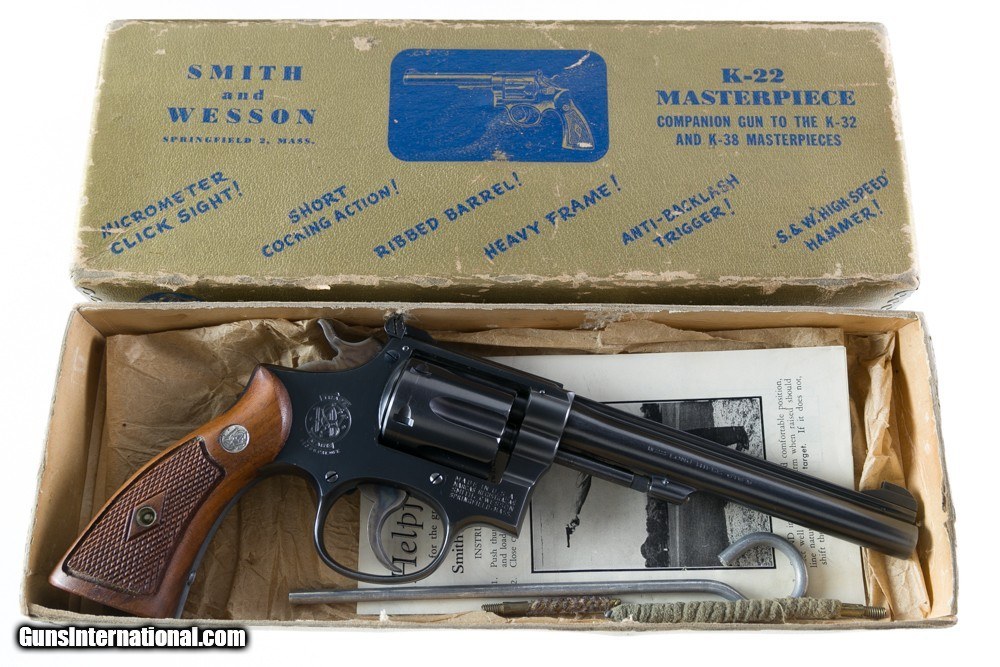
K 22 Masterpiece Serial Numbers
среда 29 апреля admin 53
Smith and Wesson made a lot of guns. We sometimes debate their efficiency at tracking serials.
I have a K-22 Masterpiece, pre model number, with 2 numbers. The bottom of the butt has K 202623, the area under the crane has number 26463 stamped there. Emotiv epoc. It's a 5 screw.
Part of our confusion comes from us not having a clear idea of how and when they were assigned, and how and when assembly numbers were assigned. Its also probably important that those methods may have changed over time (remember, they've been in business for a while.)S&W is known to hold blocks of numbers for some purposes. It means if they want to build a comemmorative, all the guns have sequential numbers. Or sometimes, anyhow. It doesn't mean they were all completed the same day or week, just that someone went to the effort to assure they had similar numbers.From what I can glean from the books on the subject, S&W logs in guns when they move from production/inspection to the 'vault', the place where they're shipped from. The letters we beg from Roy indicate another date, the date they're shipped from the vault.
It may be important that those may be the same day, or a date years later.Some guns were hot sellers. S&W is a business. They, like all other business entities have cash flow problems and concerns. If they have a completed gun, and a willing customer, they ship it.
They also completed some batch blocks of guns. Its just cheaper and easier to build the same configuration guns at the same time. Even if there isn't a ready and willing customer.We also know S&W made some ugly ducklings. Many of us don't feel that way today. But there was a time frame where you almost couldn't give away a Heavy Duty or Outdoorsman. So they languished.
Probably in the vault.All an adjacent serial number means is that the guns were probably in production at the same time, maybe even side by side for a few steps in the production process, maybe separated on different racks, too. We just don't know and Roy hasn't indicated if records exist of various guns in various stages. Its probably safe to say many gun frames were sequentially numbered at about the same time.
Its an internal control issue.But we also find guns from time to time where the factory has no records of them existing. Its not unusual for one of us to blow our meager allowances on letters. Only to get one back that says 'Open on Company books.' We have no idea what that phrase really means, but probably any of a number of things, including stolen (lunchbox guns), destroyed during production, pulled out for some reason and never shipped or sold, given to an employee for whatever reason, etc. I've got a beautiful early Centennial that came back that way. It just happens.We seem to read way to much into serial numbers. A lot of are willing to pay a premium, some time a multiple of fair market, just to obtain a desireable number.
I've done it before and I'll do it again. The family (my family) owns 2 637s. Younger son covets the one with a 'CCW' prefix. Two reasons, he doesn't clean his guns, and the CCW is new/pristine, and its just a cool number.
Sebago Son owns a K22. He mercilessly lofts it over my head because he located it in a chicken coop, and because it has K117 on the underside.
All I've managed to score are K155 and K166. And I was mad at Blake (one of our posters) because he let K141 escape to an unwashed heathen owner. The guy who owned K137 wouldn't sell it to me, nor would the owner of K188.So maybe I should rephrase the first sentence of that last paragraph. I read way too much into serial numbers!
F.t.B D Green has it right. Researching serial numbers, by the historian,starts with the shipping ledgers. These were ( and perhaps still are)bound volumes that were pre-printed with serial numbers, in numericalorder. There are several sets of these books, because there weredifferent models with the same serial numbers.When a gun was shipped, its serial number was located in the rightbook, and the shipping date, and destination are recorded in the book,on the line that contains its preprinted serial number.
This is whereall history starts. And, as you can see, this scheme is independentof when the gun was actually manufactured.Given a serial number, and a model, the shipping ledger yeilds one oftwo pieces of information. Either there is a shipping date, or therest of the line is blank, meaning that the serial number is open onthe shipping ledger.Assuming there is a shipping date, that now becomes the key intothe invoice ledgers, which are books ordered by shipping date.
Knowingthe shipping date, and the destination, the historian goes throughthose entries ( all together ), and tries to locate the invoice by usingthe destination information ( name of person/business receiving thegun). Once the invoice is located, then hopefully it will containinformation on how the gun was configured, if it was special.Sometimes the invoices have useful information, sometimes not.Sometimes target revolvers are identified as such, sometimes not.The price of the revolver is on the invoice, of course, and from thatthe historian can tell if the gun had adjustable, or fixed sights.Note that nowhere in any of this research trail is the date ofmanufacture.Regards, Mike Priwer. The factory manufactured frames in 'runs'.
100 or 1,000 or even perhaps 5,000. As these runs were done, the frames were each given a serial number. The parts were also given an assembly number to keep all of the matching and hand fitted parts together during the assembly process. Even stocks that were fitted to the frame received a serial number. Once the guns were completed, they were boxed and stored in the vault awaiting shipment.
IIRC, the factory even jumped around within given serial number blocks just to keep the competition from figuring out how many guns they were producing at any given point in time.When an order was received for a given model, the shipping clerk went into the vault and pulled the necessary guns for shipment. The clerk did not pay attention to serial number order as these were pieces of inventory and he only needed a correct number of the correct model to fill the order.
The serial numbers were recorded as they left the factory for inventory control purposes but not as a method of dating the guns manufacture.S&W was in the business to make and sell guns in the present and did not think about how crazy collectors would get at some future time about serial numbers and their relationship to dates.The books can give you a range of serial numbers used for a particular model and the basic years that these guns were manufactured, however, looking at a serial number chart does not give you the actual manufacture or shipping date. Only the company historian can give you that by looking up the serial number in the shipping ledgers.We have seen many cases where a lower serial number gun has a shipping date far later than a gun with a higher serial number.It is possible that somewhere there are records, like the day books, that show what serial numbered guns were built on any given day and hence supply the date of manufacture, but the historian uses the shipping records and thus those are the shipping date.I hope that this helps.
It sounds confusing, but it really isn't if you think about it.The Smith & Wesson Historical Foundation and its effort to digitize the company records may afford future collectors the ability to search a given serial number and find all relevant company records and correspondence pertaining to that gun. Unfortunately, that is thousands of investment dollars away. So support the SWHF by sending what you can today!!! Hello I'm looking at a k-22 ser# 99945 on the frame and swing arm but the # on the cyl does not match. Were the cylinders stamp with the frame #'s? ThanksJim, the numbers visible on the opposing surfaces of frame and yoke are soft fitting numbers, not the serial number of the gun. The serial number is found on the butt of the gun, and may not be visible if covered by target stocks.
That number is also found on the rear face of the cylinder and the flat underside of the barrel. It also appears in a couple of other places, but it is harder to see.A postwar K-22 with no Model designation will have a serial number with a K prefix. And I know of one in the 640000 range that lettered as shipping in early 1932.
I wouldn't have believed it. It's almost impossible to figure out what happened during the depression.Hi all, doing a little research on a pistol which my wife's uncle is handing down to our son.Its a S&W, 6 shot 22 LR revolver, the right side of the barrel reads '22 LONG RIFLE CTG.'
All the serial numbers on the underside of the barrel, bottom of hand grip, and backside of the cylinder all match.The SN is: K210537.Can anyone give a estimation on the date of manufacture?Obviously the grips are not original, would like to get some original grips if anyone knows where I might get some at.See attached photos.Thanks in advance for your assistance.Randy. Randy, welcome to the forum. With that serial number, the gun probably shipped in 1954.The proper grips for that era are called diamond magnas. These have a relieved diamond in the checking field around the screw escutcheons on both sides.
The name magna identifies the style of grip in which the wood comes up over the sideplate and frame, rising to the height of the frame knuckle right behind the trigger. Your gun might also have come with target stocks, in which the wood follows a semicircular upper curve from the frame knuckle down to the rear trigger guard junction with the frame.The following guns are not K-22s, but they show the types of stocks I mentioned.The K-22 is a K-frame gun (or midsize), so you are looking for K-frame magnas or target stocks of the proper era. N-frame stocks are too large and J-frame stocks are too small. Old stocks can be found on Ebay, Gunbroker, and in the classified section of this forum.
Randy, welcome to the forum. With that serial number, the gun probably shipped in 1954.The proper grips for that era are called diamond magnas. These have a relieved diamond in the checking field around the screw escutcheons on both sides. The name magna identifies the style of grip in which the wood comes up over the sideplate and frame, rising to the height of the frame knuckle right behind the trigger.
Your gun might also have come with target stocks, in which the wood follows a semicircular upper curve from the frame knuckle down to the rear trigger guard junction with the frame.The following guns are not K-22s, but they show the types of stocks I mentioned.The K-22 is a K-frame gun (or midsize), so you are looking for K-frame magnas or target stocks of the proper era. N-frame stocks are too large and J-frame stocks are too small. Old stocks can be found on Ebay, Gunbroker, and in the classified section of this forum. Hi all, this is my first post here. I was given an old K22 that belonged to my grandfather. I'm trying to date it and was hoping you guys could help me.Serial: K 468XX (on bottom of grips)^^^this is a picture of the firearm. Thanks in advance to all the nice people here!Welcome to the forum.
That serial number points to 1948 manufacture, probably in the second half if we assume S&W produced and numbered their frames sequentially. (They didn't always do that.)By the way, the stocks on your gun are prewar service stocks from the early to mid 1930s. Your gun almost certainly shipped with postwar magna stocks, which are the type that rise up over the sideplate on the right and the frame on the left. Generally, it not having the original grips does influence the value. Its not all that bad since there are vultures circling and wanting the ones you have. Sometimes you can break even on the swap. Just don't expect the new ones to fit like a glove.
Back in that era they fitted the wood to the metal, then used a belt sander to make them perfectly fitted.Prices on old K22s wander all around. They've been going up.
Condition means a bunch, and so does having the correct gold box and black oxide screwdriver. Suffice it to say a 1948 K22 should be worth $800 or so, more or less based on condition and other things. I have a 6' s&w.22 with s/n 661xxx. It probably was shipped around 1935-6?It looks like it is a K-22 outdoorsman in the blue book.I bought this gun in a pawn shop in Wyoming in the early 1990's. It was the dirtiest gun I have ever had. I cleaned it andhit a can at 25 yards with the first shot out of it.Also, I just found in a store, a 4' Smith 17-3 in.22, it has some holster wear on the left side.What would be the official model of this gun?
Manufactured 1958 and later. I took numbers AVN1296 & G7x2578 off where the clyinder opens so they are probably not serial numbers.
They have $650 on it. Whats it worth? No box.This is a great site with good information and beautiful pictures. The pictures are hard on me,now I want more and nicer smiths.thank you. Why dont you give us the serial number of your gun (you can X out the last few digits if you are paranoid) and we can give you an approximate date.
Also, frames shared serial number blocks among models. In other words there would have been K22's, K32's and K38's all sharing the same serial number range. It is even possible to have consecutive serial number guns that are different models as Smith didnt do things in serial number order.Hi there, I am buying a K-22 and interested in the manufacture date, the serial number is 16 K 8343Thanks.
Smith & Wesson Model 15TypePlace of originUnited StatesSpecificationsFeed system6-round cylinderThe K-38 Combat Masterpiece, Revolver Model 15 is a six-shot, with adjustable open, built on the medium-size 'K' frame. It is chambered for the and is fitted with a 4-inch (100 mm) barrel, though additional barrel options have been offered at various times during its production. Originally known as the 'K-38 Combat Masterpiece', it was renamed the Model 15 in 1957 when all Smith & Wesson revolvers were given numerical model numbers. It is a shorter barrel version of the and essentially an adjustable-sight version of the seminal ('Military and Police') revolver with target shooting features.
The main production run of the Model 15 was from 1949 through 1999. It was discontinued for approximately a decade until 2011, when a re-tooled version was re-released under S&W's Classics Revolvers line. Contents.History The Smith & Wesson K-38 Combat Masterpiece Revolver Model 15 is a derivative of the classic 1899 K-frame (medium frame) Military and Police.38 S&W Special (aka.38 Special) six-shot double-action revolver. The M&P underwent steady evolution throughout the 20th century and S&W spun off several variations as separate models in the post World War II years. One of these was the K-38 Target Masterpiece, which began production in 1947. The Target Masterpiece included a number of new and/or special features, including a six-inch barrel with a narrow rib to provide a level sight plane, a Patridge front sight, a micrometer click rear sight, S&W’s.375” short-throw hammer, a trigger adjustment for overtravel, and improved grips. Noting the accuracy of the Target Masterpiece, a number of police departments and the FBI soon requested the same revolver with a four-inch barrel and a Baughman Quick Draw front sight.
The result was the K-38 Combat Masterpiece. The major distinction between the K-38 Target Masterpiece and the K-38 Combat Masterpiece is the barrel length and the front sight.In 1957 the K-38 Combat Masterpiece was renamed the Model 15 when all Smith & Wesson revolvers were given numerical model numbers. (The Military & Police and the Target Masterpiece were renamed the Model 10 and Model 14 respectively.) The model number is stamped on the frame behind the cylinder yoke, so it is visible (only) when the cylinder is open. A number of production and engineering changes have been made throughout the years, some of which are noted by a dash number suffixed to the Model number (15-1, -2, -3).Over the years the Model 15 has been produced with several barrel lengths, with 4' (standard) and 2' (1964–1988) being the most common. In 1972 S&W released a stainless steel version as the Model 67. In 1997 the hammer and internal lockworks were modified from an on-the-hammer firing pin / internal hammer block to a floating firing pin / flat hammer, and kept the hammer block that, unlike a transfer bar safety design, moves up with the trigger pull.
The hammer hits a transfer bar, transferring the strike to the firing pin, while the block in a hammer block system moves down with the trigger pull, unblocking the hammer from the firing pin, allowing the hammer to strike the firing pin. These two safety systems work oppositely, but achieve the same goal of only allowing the gun to fire when the trigger is pulled all the way.The Model 15 was a popular sidearm for law enforcement and was the standard issue sidearm of the from 1962 until 1992 when it was replaced by the pistol. Production of the Model 15 was discontinued in 1999 when Smith & Wesson was purchased and reorganized, although a couple limited run 'Heritage Series' models were released in 2001 and 2002. In 2011 Smith & Wesson re-introduced the Model 15 (15-10) under their Classics Revolvers line, newly machined, with a shrouded redesigned barrel, and a built-in trigger lock (located just above the cylinder release thumbpiece on the left side). Specifications. Caliber:.38 S&W Special. Capacity: 6.
Barrel: 4” (standard configuration). Length overall: 9 1/8” With 4” barrel. Weight loaded: 34 oz. With 4” barrel.
Sights: Front – 1/8” Baughman Quick Draw on plain ramp. Rear: S&W Micrometer Click Sight, adjustable for windage and elevation. Frame: square butt with grooved tangs. Stocks: checked walnut service with S&W monograms. Finish: S&W blued with sandblasting and serrations around sighting area to break up light reflections.
Trigger: S&W grooving with adjustable trigger stop. Ammunition:.38 S&W Special,.38 S&W Special Mid Range,.38 + pEngineering and production changes timeline. 'K-38 Combat Masterpiece Revolver Model 15', designed by Flora Mitchell Van Orden, wife of Brig.
Gen., USMC, with the attention of Tiny Helwig at the S&W head office in 1949, is the full name as it appears on the cover of the S&W owners manual. ^ Supica, Jim; Nahas, Richard (2007). Iola, Wisconsin: F+W Media, Inc.
Pp. 346–347. Owner’s Manual K-38 Combat Masterpiece Revolver Model No. 5101A). Military.38 Special Ammunition, The American Rifleman (March 1982), p. 68External links Wikimedia Commons has media related to. (same process and general parts as Model 15). (same process and general parts as Model 15).